This guide is a science-first, risk-aware overview of how stem cell therapy is being explored in longevity and aging contexts today. It explains why people travel internationally for these treatments, what the underlying biology actually supports, and how to think responsibly about destinations, safety, and expectations. If you are evaluating longevity stem cell therapy seriously, this article is designed to help you ask better questions, understand trade-offs, and avoid hype-driven decisions. It is not written for miracle seekers, and it does not promote shortcuts or medical guarantees.
Last updated:
February 3, 2026
As people live longer, a more important question is taking center stage:
How do we stay strong, functional, and resilient as we age... not just alive?
This shift from lifespan to healthspan has accelerated interest in advanced longevity strategies, including stem cell therapy for longevity and aging.
The appeal is understandable. Recovery slows, inflammation accumulates, and the body’s ability to repair itself declines with age.
Yet for many individuals in the US, Canada, and much of Europe, access to systemic regenerative therapies remains limited outside tightly regulated clinical trials.
As a result, a growing number of patients are looking internationally for options.
At the same time, stem cell therapy is not a consumer product. Longevity medicine is not about hype, guarantees, or anti-aging shortcuts.
Outcomes vary, evidence is still evolving, and safety depends heavily on how (and where) these therapies are delivered.
Before comparing the best countries for stem cell therapy for longevity and anti-aging, it’s essential to establish a clear foundation:
That context is what allows informed decisions and separates responsible longevity medicine from marketing-driven claims.
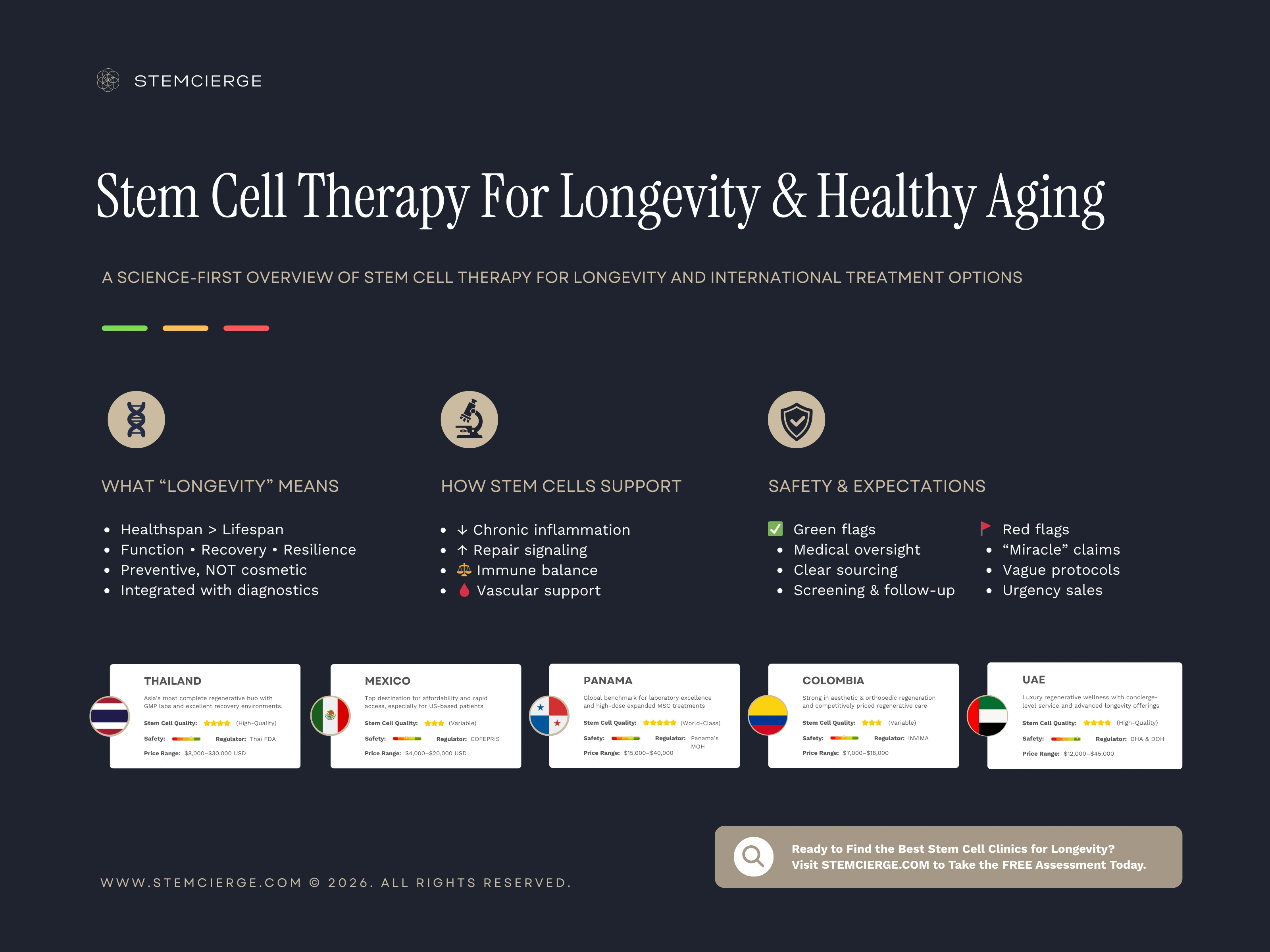
Stem cell therapy for longevity is not cosmetic anti-aging and not an attempt to “reverse” age.
In regenerative medicine, longevity refers to supporting the biological systems that decline with age, particularly:
This approach aligns with how longevity is defined in clinical research: improving healthspan, not immortality¹.
In practice, stem cell therapy is explored as a supportive intervention for longevity.
Often alongside diagnostics, lifestyle optimization, and recovery protocols and NOT as a standalone solution.
Aging is no longer viewed as simply “getting older.”
Modern science understands aging as a biological process driven by multiple changes happening inside the body over time.
Some of the most important drivers include:
Research shows that mesenchymal stem cells (MSCs), key regulators of repair and immune balance, become less effective with age.
Their ability to communicate with other cells and coordinate healing gradually declines⁴.
Stem cell therapy does NOT stop or reverse aging.
However, when used responsibly, it may help modulate some of these biological drivers.
Particularly it may reduce chronic inflammation, impaired repair signaling, and immune imbalance.
Most longevity-focused stem cell therapies use mesenchymal stem cells (MSCs) because of how they interact with the body at a systems level.
Rather than replacing damaged tissue directly, MSCs function as biological communicators.
They release signaling molecules: including cytokines, growth factors, and extracellular vesicles that help coordinate how surrounding cells respond to inflammation, injury, and stress.
Inflammation modulation
MSCs help regulate chronic, low-grade inflammation by downshifting pro-inflammatory signaling pathways that become overactive with age²⁻⁵.
Tissue repair signaling
Instead of turning into new tissue themselves, MSCs signal the body’s own cells to repair and regenerate damaged areas more effectively³.
Immune system rebalancing
MSCs are known for modulating immune responses rather than overstimulating them: an important distinction in aging, where immune overactivation can be harmful⁶.
Vascular and endothelial support
Healthy blood vessels are essential for brain function, metabolic health, and overall resilience.
Stem cell signaling may support endothelial repair and vascular function, which tend to decline with age⁷.
Because these effects occur throughout the body, longevity-focused stem cell protocols are most commonly delivered intravenously, rather than as localized injections.
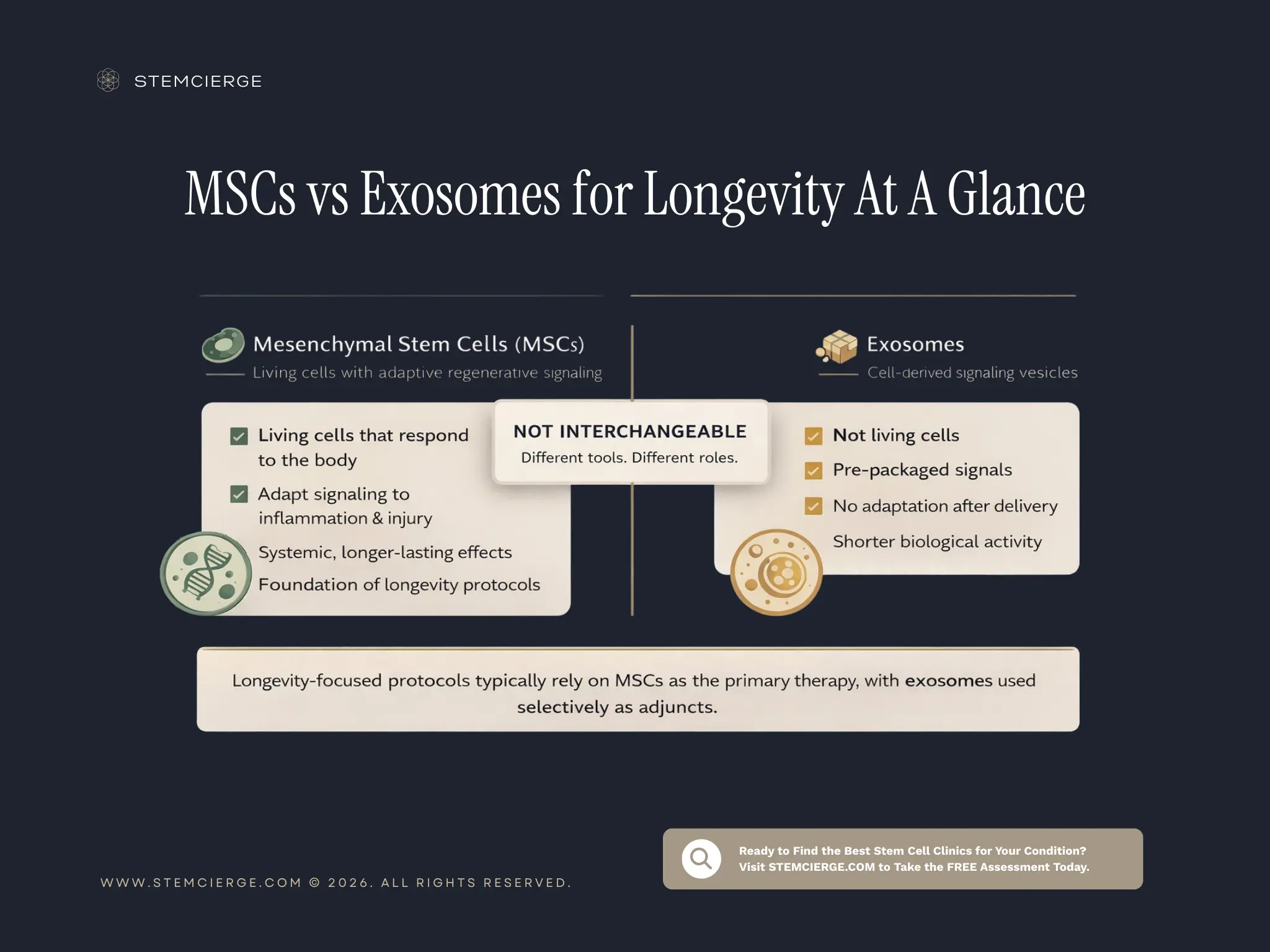
In longevity medicine, stem cells and exosomes are often discussed together, but they are not the same.
They do NOT play identical roles.
Understanding this difference is important when evaluating treatment protocols and clinic claims.
MSCs are living cells capable of responding dynamically to the body’s internal environment.
Key characteristics:
In longevity-focused protocols, MSCs are commonly used because they can adapt their signaling based on what the body needs, rather than delivering a fixed signal.
This adaptability is one reason MSCs remain the foundation of most systemic longevity stem cell therapies.
Exosomes are cell-derived signaling vesicles, not living cells.
They contain proteins, RNA, and other molecular signals that cells use to communicate.
Key characteristics:
In longevity settings, exosomes are often used as adjuncts, rather than standalone therapies.
For example, to support recovery or enhance local tissue signaling.
Both MSCs and exosomes can play roles in regenerative medicine, but they are not interchangeable.
High-quality longevity programs may combine both, depending on patient goals and protocol design.
However, claims that exosomes “replace” stem cells oversimplify the biology.
For systemic longevity and aging support, MSCs remain the primary therapeutic tool, with exosomes used selectively where appropriate⁸.
Longevity-focused stem cell therapy is most commonly explored by:
It is not appropriate for:
Ethical providers emphasize selection and suitability, not universal eligibility.
In the U.S. and much of Europe, systemic stem cell therapy for aging is largely restricted outside clinical trials⁹.
Medical tourism destinations often allow:
There is no universally “best” country — only a best fit based on goals, medical profile, and risk tolerance.
For a detailed breakdown, check our pillar guide:
Country reputation alone is not enough.
What truly varies:
Two clinics in the same country can differ dramatically in safety and quality.
This is why clinic evaluation matters as much as destination choice.
The International Society for Stem Cell Research (ISSCR) emphasizes that many stem cell applications remain experimental and must be approached with caution¹⁰.
Strong safety signals include:
Red flags include outcome guarantees, vague sourcing, and urgency-driven sales tactics.
Longevity medicine should be deliberate, not impulsive.
Stem cell therapy for longevity is best understood as:
A regenerative support strategy: not a shortcut to youth, and not a replacement for lifestyle, nutrition, or training.
When done responsibly, it may support:
The key is informed decision-making: grounded in science, standards, and realistic expectations.
If you’re exploring stem cell therapy abroad for longevity, the most important step is understanding whether it actually fits your goals, health profile, and timeline.
👉 Take the FREE STEMCIERGE Evaluation QUIZ
A short, science-guided evaluation designed to help determine:
Q: What is stem cell therapy for longevity and aging?
Stem cell therapy for longevity focuses on supporting biological functions that decline with age, such as inflammation control, tissue repair signaling, immune balance, and recovery. It is not cosmetic anti-aging and does not stop or reverse aging.
Q: Is stem cell therapy proven to slow or reverse aging?
No. Stem cell therapy does not reverse aging. Current research suggests potential benefits for inflammation modulation and functional support, but outcomes vary and evidence is still evolving.
Q: What type of stem cells are used for longevity therapy?
Most longevity protocols use mesenchymal stem cells (MSCs), commonly sourced from umbilical cord tissue or adult stem cells, due to their regenerative and immunomodulatory properties.
Q: Are exosomes the same as stem cells for longevity treatments?
No. Exosomes are signaling particles, not living cells. They are often used as adjuncts, while stem cells remain the primary tool for systemic longevity support.
Q: Why do people travel abroad for stem cell therapy for longevity?
Many countries restrict systemic stem cell therapy outside clinical trials. Some international destinations offer broader access to MSC therapies and integrated longevity programs under different regulations.
Q: Which countries are popular for longevity-focused stem cell therapy?
Common destinations include Mexico, Panama, Thailand, Colombia, Malaysia and Turkey. Each differs in regulation, cost, clinic standards, and treatment focus.
Q: Is stem cell therapy for longevity safe?
Safety depends on clinic quality, cell sourcing, physician oversight, and patient screening. Longevity stem cell therapy is still considered experimental.
Q: Who may be a good candidate for longevity stem cell therapy?
Candidates are typically adults over 40 focused on preventive aging, recovery, or early degenerative conditions. It is not suitable for those seeking guaranteed or cosmetic-only results.
Q: How long do the effects of longevity stem cell therapy last?
There is no fixed duration. Effects vary based on health status, protocol design, and lifestyle factors. Stem cell therapy should be part of a broader longevity strategy.
Q: How can I determine if stem cell therapy abroad is right for me?
A structured medical assessment is essential to evaluate goals, health profile, and risks before considering stem cell therapy or international treatment options.
¹ World Health Organization (WHO).
Healthy Ageing and the Decade of Healthy Ageing 2020–2030.
World Health Organization, Geneva.
https://www.who.int/initiatives/decade-of-healthy-ageing
² Franceschi, C., Garagnani, P., Parini, P., Giuliani, C., & Santoro, A.
Inflammaging: a new immune–metabolic viewpoint for age-related diseases.
Nature Reviews Immunology, 2018.
https://doi.org/10.1038/s41577-018-0006-9
³ Caplan, A. I.
Mesenchymal Stem Cells: Time to Change the Name!
Stem Cells Translational Medicine, 2017.
https://doi.org/10.1002/sctm.17-0051
⁴ Stolzing, A., Jones, E., McGonagle, D., & Scutt, A.
Age-related changes in human bone marrow-derived mesenchymal stem cells: consequences for cell therapies.
Mechanisms of Ageing and Development, 2008.
https://doi.org/10.1016/j.mad.2008.03.002
⁵ Golpanian, S., DiFede, D. L., Khan, A., et al.
Allogeneic human mesenchymal stem cell infusions for aging frailty.
The Journals of Gerontology: Series A, 2017.
https://doi.org/10.1093/gerona/glw153
⁶ Uccelli, A., Moretta, L., & Pistoia, V.
Immunoregulatory function of mesenchymal stem cells.
Nature Reviews Immunology, 2008.
https://doi.org/10.1038/nri2348
⁷ Madonna, R., Van Laake, L. W., Davidson, S. M., Engel, F. B., & Hausenloy, D. J.
Position paper of the ESC Working Group: cell-based therapies for myocardial repair and regeneration.
Circulation Research, 2019.
https://doi.org/10.1161/CIRCRESAHA.118.313073
(Used to support endothelial and vascular aging claims)
⁸ Phinney, D. G., & Pittenger, M. F.
Concise Review: MSC-Derived Exosomes for Cell-Free Therapy.
Stem Cells, 2017.
https://doi.org/10.1002/stem.2575
⁹ U.S. Food & Drug Administration (FDA).
Consumer Alert on Regenerative Medicine Products Including Stem Cells and Exosomes.
https://www.fda.gov/vaccines-blood-biologics/safety-availability-biologics/consumer-alert-regenerative-medicine-products
¹⁰ International Society for Stem Cell Research (ISSCR).
ISSCR Guidelines for Stem Cell Research and Clinical Translation (2021 Update).
https://www.isscr.org/guidelines


-min.png)